

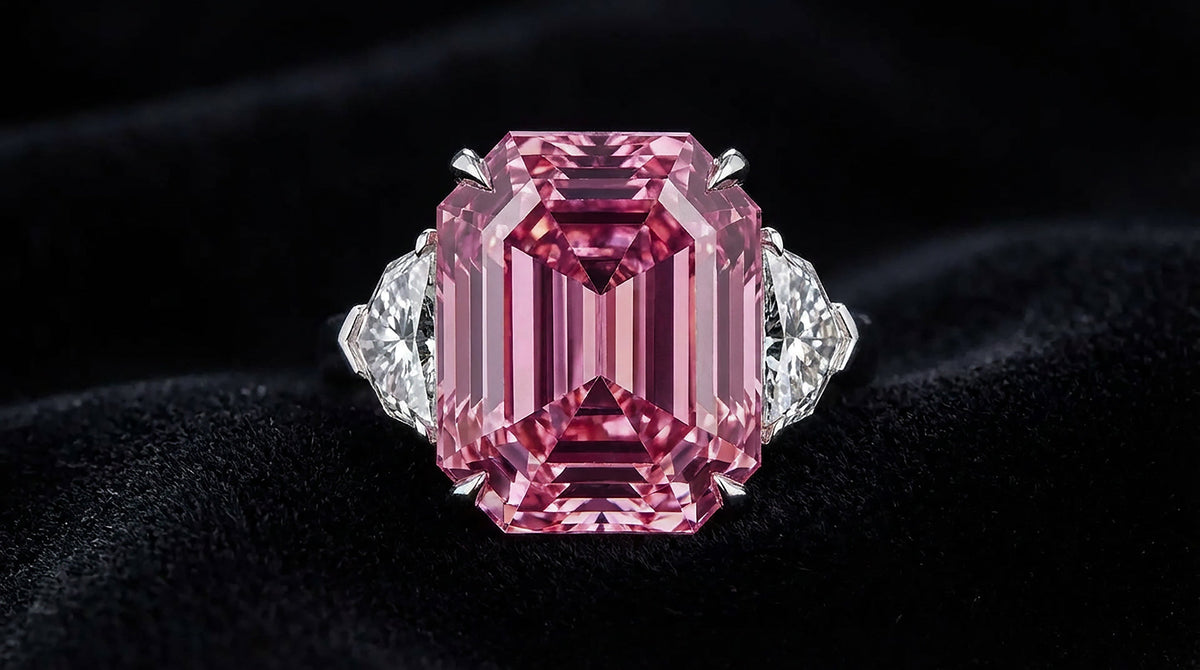
The World's Largest Pink Diamonds
Hold a fine pink diamond beside a colorless one of the same size and the difference is not the one most people expect. The pink does not sparkle harder. It is quieter. The color sits down inside the stone rather than flashing off the surface, and the longer you look, the more it is the color you are looking at rather than the light.
That quality is the reason a single pink diamond sold for seventy-one million dollars. Not marketing, and not fashion. Scarcity, and a kind of scarcity that has no remedy, because the place that produced most of them is closed.
The Largest Pink Diamonds in the World
This question has three different answers depending on what is being asked, and the three get confused constantly, including by people selling stones.
What is the largest pink diamond in the world?
The Daria-i-Noor, at an estimated 182 carats. It is a pale pink table-cut stone from the Golconda mines of India, and it has been part of the Iranian crown jewels for centuries. It is held today in the Iranian National Jewels collection in Tehran. It will never be sold, and its color is nothing like the saturated pinks that set auction records.
What is the largest pink diamond ever found?
In modern times, the Lulo Rose: a 170 carat pink rough recovered in 2022 from the Lulo mine in Angola, and the largest pink diamond found in roughly three hundred years. A rough stone is not a finished one. By the time a rough of that size is cut, a great deal of it is gone.
The stone most people actually mean is the Pink Star. At 59.60 carats, Fancy Vivid Pink and Internally Flawless, it is the largest diamond of that color and clarity ever graded by GIA. It was mined in Africa in 1999, and in April 2017 it sold at Sotheby's Hong Kong for 71.2 million dollars. There is no second stone like it, at any price.
Famous pink diamonds and what they sold for
The records are worth knowing, because they establish what the market pays when rarity, size, and color align.
The Williamson Pink Star, an 11.15 carat cushion, Fancy Vivid and Internally Flawless, sold in October 2022 for 57.7 million dollars after nearly fifty bids. The price worked out to roughly 5.17 million dollars per carat, close to double the previous per-carat record.
The Winston Pink Legacy, 18.96 carats and vivid pink, sold for 50.7 million dollars in November 2018.
The Graff Pink, 24.78 carats and fancy intense, sold for 46.1 million dollars in 2010 and held the record for years.
Note what the Williamson price tells you. It is the smallest stone on that list by a wide margin and it commanded the highest price per carat. Size is not what the market is paying for. Purity of color is.
How Rare Are Pink Diamonds?
Fewer than 0.15 percent of all diamonds graded by GIA are predominantly pink. That is roughly one stone in every six hundred and change, and it counts every pink, including the pale ones that most buyers would walk past.
Narrow it to stones a collector would actually want and the number collapses. Fewer than one pink diamond in ten weighs more than 0.20 carat. Only about four percent carry color deep enough to be graded Fancy Vivid. A vivid pink of any real size is not a rare stone in the way people use that word about jewelry. It is closer to a geological accident that happened to survive.
Why are pink diamonds so rare?
Most colored diamonds owe their color to a trace element that slipped into the crystal while it grew. Nitrogen produces yellow. Boron produces blue. Pink works differently, and that difference is the whole story.
A pink diamond has no coloring element in it at all. The color comes from damage. Under enormous pressure deep in the earth, the crystal lattice was pushed out of alignment, and those distorted planes absorb light in a way the eye reads as pink. The stone is bent, and the bend is the color.
This is why pinks cannot be produced to order by geology in any reliable way. The conditions have to be violent enough to deform the lattice and gentle enough to leave a diamond worth cutting, and those two requirements are close to contradictory.
How many pink diamonds are there in the world?
Nobody can give you an honest number, and anyone who does is guessing. What can be said is how few reach the market. For decades the Argyle mine held an annual tender that was the primary source of investment-grade pinks in the world, and that tender offered a few dozen stones a year. Not a few dozen carats each. A few dozen stones, total, for the entire global market.
What Is a Pink Diamond Worth?
There is no per-carat table for pink diamonds the way there is for colorless ones, and treating a price guide as gospel here will mislead you badly. Value is driven by color first, and everything else is secondary.
Why are pink diamonds so expensive?
Four things, in this order.
Color intensity: A Fancy Vivid is not incrementally more valuable than a Fancy Light. It is a different market. Any brown or gray as a secondary hue pulls the value down sharply, and pure saturated pink with no modifier is what the record prices are made of.
Carat weight: Because the rough is so rarely large, size compounds with color rather than adding to it. A five carat vivid pink is remarkable. A ten carat vivid pink belongs in a museum.
Clarity: Only about seven percent of pink diamonds grade Flawless or Internally Flawless, and most are Slightly Included. For a pink, clarity matters far less than it does for a colorless stone, and a visible inclusion in a vivid pink is usually forgiven. When top color and top clarity arrive together, the price stops behaving linearly.
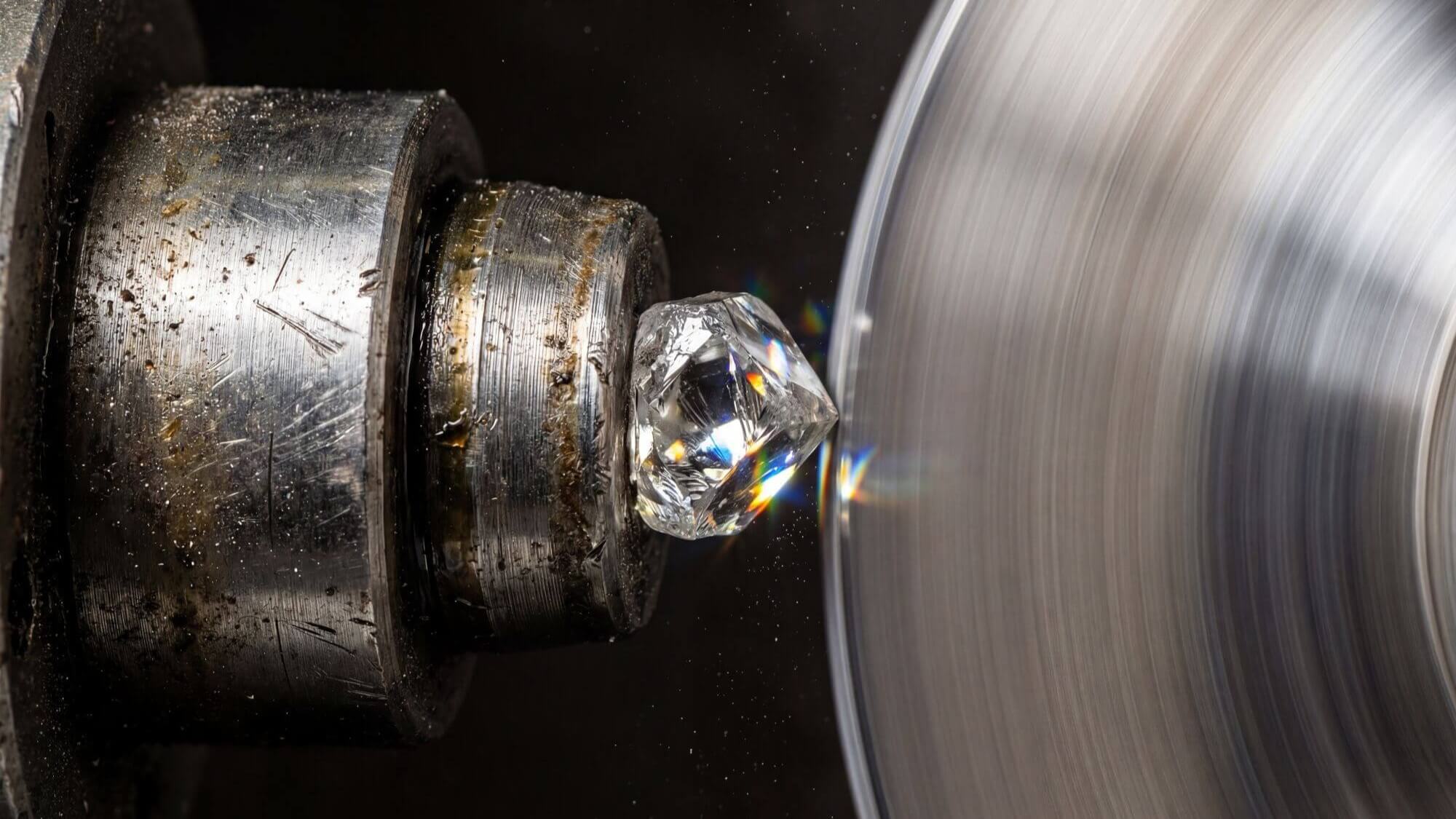
Cut: Pinks are cut as cushions, ovals, pears, and radiants rather than round brilliants, and for a reason. A round brilliant is engineered to return white light. Those same proportions wash color out. A cutter working pink rough is not chasing sparkle. Every decision serves color retention, even at the cost of weight.
How does GIA grade pink diamond color?
On a scale that runs Faint, Very Light, Light, Fancy Light, Fancy, Fancy Intense, Fancy Vivid, and Fancy Deep. The grade is assigned from the face-up appearance of the whole stone, which is why fancy color grading is judged so differently from the colorless scale, where the goal is the absence of color rather than the presence of it.
Are Pink Diamonds Real? Natural, Treated, and Laboratory-Grown
This question comes up more than any other, and it deserves a direct answer: yes, natural pink diamonds are real diamonds, and they are the rarest thing in the case. But a large share of the pink diamonds offered for sale today are not natural pinks, and the distinction is worth several orders of magnitude in value.
There are three categories. A natural pink took its color from lattice distortion in the earth. A treated pink began as a less valuable diamond and was irradiated and annealed until it turned pink. A laboratory-grown pink was made in a matter of weeks and, in most cases, treated afterward to bring up the color.
All three are genuinely diamond. Only one of them is rare, and the price difference between the first and the last is not a discount. It is a different product.
How can you tell if a pink diamond is real?
Not by looking at it. That is the honest answer, and anyone who claims otherwise is either untrained or hoping you are. A well-made treated pink and a well-made laboratory-grown pink can both be beautiful, and neither announces itself across a counter.
The distinction is made in a laboratory, using instruments that read the stone's growth structure and spectroscopic signature. In practice this means one thing for a buyer: for any pink diamond of consequence, insist on a GIA report that states the origin of the color. A stone worth six or seven figures without a report is not a bargain. It is an unanswered question, and the answer is usually the reason the price looked good.
If you want the longer version of how grown stones differ from mined ones, we covered it in lab grown versus natural diamonds.
Where Pink Diamonds Come From
The overwhelming majority came from a single mine: Argyle, in the remote east Kimberley of Western Australia. Argyle was never known for large stones, but the color it produced was unmatched, including the purplish pinks and the reds that no other source has replicated.
Argyle closed in 2020. There is no replacement, in volume or in quality.
Pinks still surface elsewhere. The Golconda mines of India produced the historic stones centuries ago. Angola, Brazil, Russia, and South Africa all yield the occasional pink. But none of them produces them in a way that could be called supply.
So the question answers itself. An already impossibly rare stone lost its only meaningful source, while demand did not move. Prices rose, and there is no mechanism by which they come back down. A stone with documented Argyle provenance is not merely rare now. It is finite, and the total number in existence will never increase.
If You Own or Inherit a Pink Diamond
Have it evaluated properly before you do anything else. Not appraised at a counter by someone reading a price sheet, but examined by a gemologist who works in fancy color, because a single grade of color intensity can move the value by a multiple, and a secondary brown hue that an untrained eye reads as warmth can halve it.
As a GIA Graduate Gemologist, I can assess color grade and clarity, tell you whether the color is natural or the result of treatment, and advise whether a laboratory report is worth pursuing for your particular stone. That report becomes part of the stone's provenance, and provenance is a real component of what a pink is worth. Once you have it, make sure the piece is insured against the appraised value rather than a guess.
If the stone is going to be worn rather than held, the setting matters more than it does with almost anything else. Pink wants room. A design that crowds it, or surrounds it with stones that compete, will flatten the color you paid for. The way a piece is built around a fancy color stone determines how much of that color ever reaches anyone's eye, which is the same principle that governs a custom engagement ring and every piece in the Works of Art Collection.
You do not need a laboratory to start reading a pink diamond. Take it to a window, away from the warm lights of a jewelry case, and look straight down through the table. Ask yourself whether the color is pink or whether it is pink with something else living underneath it. Then ask what the paperwork says about where that color came from. Those two questions separate most of the market.
When you want the rest of the answer, a private consultation at Demirjian Jewelry Design is where that begins: understanding the stone, understanding what it is actually worth, and deciding together what it deserves to become.


Leave a comment
This site is protected by hCaptcha and the hCaptcha Privacy Policy and Terms of Service apply.